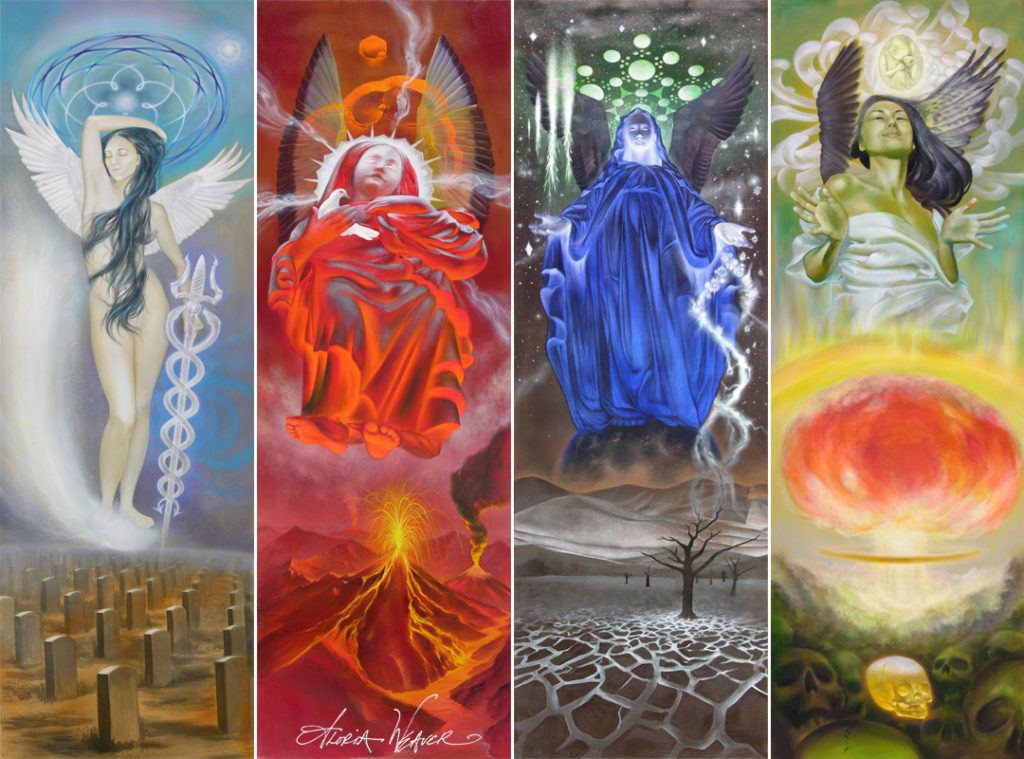
Oil & Tempera on Canvas
In collaboration with David Heskin
2012
The Four Angels of the Apocalypse
The Four Horsemen of the Apocalypse are described in the New Testament of the Bible called the Book of Revelation of Jesus Christ to Saint John the Evangelist. In God’s right hand is a book/scroll sealed with seven seals. Jesus opens the first four of the seven seals, which summons forth four beings that ride out on white, red, black, and pale (or green) horses. The four riders are commonly seen as symbolizing Conquest, War, Famine, and Death, respectively. The Christian apocalyptic vision is that the four horsemen are to set a divine apocalypse upon the world as harbingers of the Last Judgement.
While the word apocalypse is often defined as “the complete final destruction of the world, or an event involving destruction or damage on a catastrophic scale”, the etymology of the word “apocalypse” is the Greek “apokaluptein” (from apo- “un-” + kaluptein “to cover”) meaning to “uncover” or “reveal”. The apocalypse then, can be seen as a revealing of something that has been hidden.
Cultures around the world have prophesied the “end of time” and many have interpreted this as meaning the end of Earth. Fundamentalist religious groups await the destruction of the world, which will supposedly bring the return of a messiah or savior and the “chosen ones” will be saved or spared. While the figure is different according to each religion, the storyline remains essentially the same, and looking more deeply into the symbolism of these religions, we find one story told around the world. This singular story, told across all cultures and religions since the beginning, has a much deeper cosmological interpretation when seen through myth and archetype.
Our quest is to envision the concept of an apocalypse, not as the destruction or annihilation of the world, but as an awakening that will enable the creation of a liberated new world. While there is often chaos before creation, death before rebirth (the Italian Renaissance was preceded by rampant wars and plagues), it is in seeing the greater picture as a whole that these forces can be better understood. Catastrophic influences exist at every scale- from the microcosmic, to the macrocosmic planetary and galactic scales. Destructive urges within humanity exist to be reconciled as expressions of collective unconscious energy, understood as symbolic acts of recreating past events, in order that they may be healed and transformed. By focusing on the transcendent opposites of these archetypal forces, we call forth the inner light to cast its resplendent rays into the shadows and awaken the sleeper.
The end of a time does not signify the end of life, only the beginning of a new era yet to come. If one meditates upon the paradox and seeming contradictions held within these compositions, an illuminating beam of gnosis may emerge from the innermost self. This heightened awareness ceases to define existence through distinctions of polarity, but instead recognizes an interconnectedness and unity underlying all life. Layers of metaphorical meaning await our inquiry, for these four paintings tell numerous stories which overlay many interpretations (mythic, religious, scientific, astronomical, cosmological, etc.) as they offer many points of entry along the journey to Truth.
Purchase archival reproductions of The Four Angels.
White Angel of Liberation Vanquishing Conquest
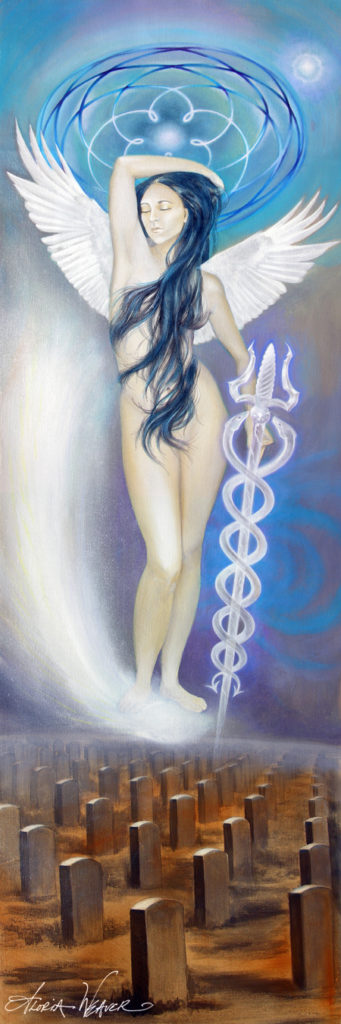
A re-visioning of the well-known “Birth of Venus” paintings, with a deeper understanding of the planet Venus as the Great Comet of antiquity, and identifying the Birth of Venus as an actual event in the beginning of recorded history. Venus was once a beautiful and terrifying comet and the Saturnian planetary configuration created a cataclysmic event that shaped human consciousness, often referred to across cultures as “the great battle in the heavens”.
A Thunderbolt Caduceus (symbolizing both healing as well as the cosmic plasma discharge formation) points down to a military graveyard on the reddish planet, Mars. The goddess is crowned by her planet’s orbital pattern as seen from Earth, the five inferior conjunctions of Venus.
The drive for conquest and subjugation is a collective expression of an unconscious fear of being annihilated, perhaps by a great planetary cataclysm. Understanding the truth of ancient history and bringing to light collective unconscious memory is a path to freedom. True liberation is immune to subjugation and defies conquest; the goddess/planet Venus also represents love and is known as the “morning star” signifying the arrival of the dawn after a period of darkness.
Red Angel of Peace Overcoming War
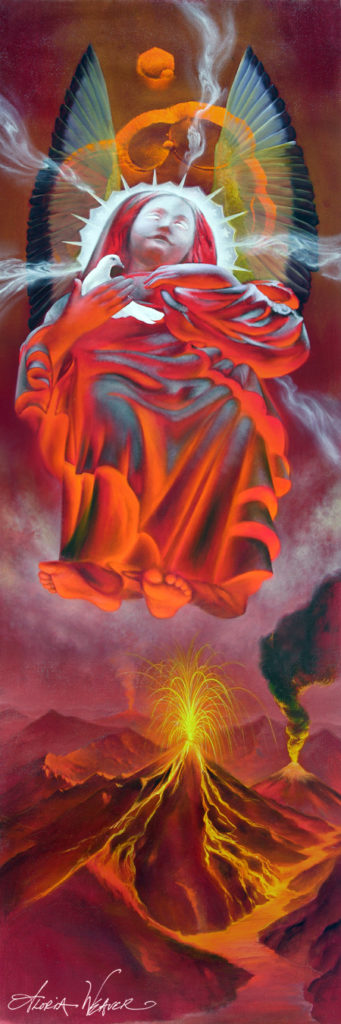
The planet Mars is the archetypal warrior-hero, the ultimate model for kings in all civilizations and cultures worldwide. In this interpretation, peace is found through accepting and forgiving violence and upheaval in the past. The intense planetary interactions between Mars and Venus in the prehistorical epoch continue to affect the core of humanity, as viewed through this lens, all war is an unconscious expression of the collective human trauma incurred when Earth experienced destruction and violence on a planetary scale as a result of cosmic events.
Wearing the crown of Venus, the Angel of Peace creates a bridge to this ancient story. Plasma discharge flows from her crown to electrically sculpt and scar the entire surface of Mars, illuminated in the distinct and clear scalloped detail of the Olympus Mons Caldera.
The current scientific interpretation of Olympus Mons is that of a shield volcano, although it matches none of the characteristics of the shield volcanoes known on Earth. Rising above the volcanic landscape (transcending old-paradigm understanding as well as the destruction symbolized by the volcano’s eruption), the Angel of Peace holds in her hands a white pigeon- an apt symbol for peace in the modern urban environment.
Black Angel of Abundance Relieving Famine
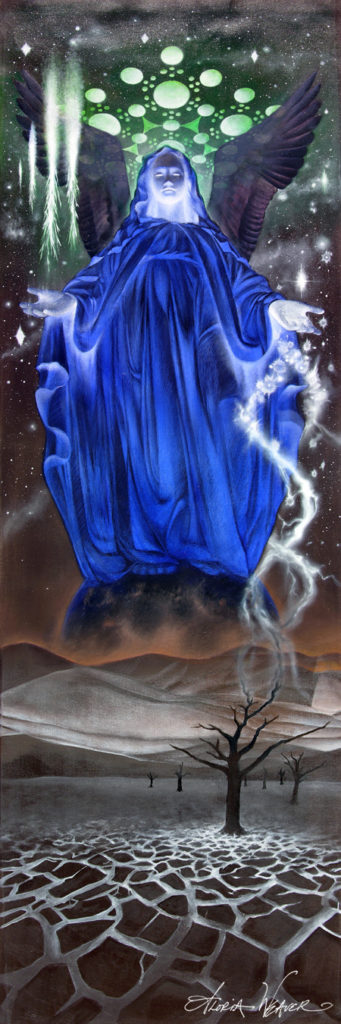
The idea that there are limited resources, or finite supplies of energy (whether on Earth or beyond) is due to a lack of true understanding. The Universe is 99% plasma. It is electrical in nature and is made up of an infinitely available energy. This energy is the source and substance of all matter. Once humanity learns how to stop burning fossil fuels, competing for resources and how to source free energy from the Electric Universe, it is possible that there may be no more famine, no lack.
The Angel of Abundance hovers over a parched and cracked desert landscape, offering the infinite source of sustaining energy to reawaken the true awareness of the life force. In her hands, upper atmospheric sprites flash, translating cosmic energy to Earth. Helical circuits and bead lightning constitute the birthplace of stars in the cosmos.
The Angel’s crown is a crop circle, symbolizing the cosmic infinitude of life. The world-wide crop circle phenomenon presents information in the form of mathematical codes and geometrical patterns, while also infusing this information into food source crops, sharing galactic intelligence with humanity on a sub-cellular level.
Green Angel of Rebirth Transcending Death
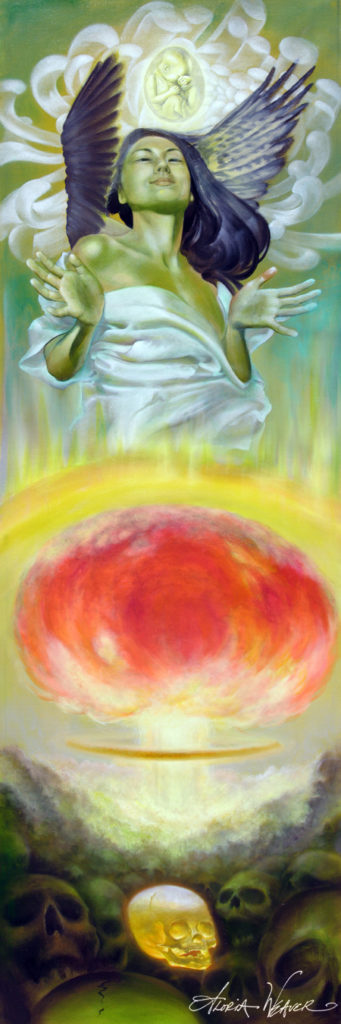
This piece recognizes humanity’s use of nuclear power as fundamentally destructive (as evidenced by the nuclear devastation of Chernobyl and Fukushima). The current hypothesis of gravitational cosmology regards our Sun (and all stars) as thermonuclear reactors. The Electric Universe offers a transcendent understanding of stars as electrodynamic phenomena, redefining our concept of energy and leaving behind the old-paradigm nuclear model.
The Angel of Rebirth rises above a nuclear explosion, beneath which the skull of a baby glows amongst the masses of the dead. Above the mushroom cloud, an aurora shimmers (a subtle reference to Kristian Birkeland’s theory that the Aurora is due to ‘charged particle beams’ from the Sun, which has only recently been confirmed).
The Angel offers up an egg, the symbol of life and fertility, within which a human fetus awaits genesis, signifying the birth of a new consciousness. From the Angel’s crown, a chrysanthemum blooms. This flower is symbolic of death and grief in many countries such as Japan, Korea and China, as well as in Europe, but it is generally regarded as positive and cheerful throughout most of the United States. While the chrysanthemum serves as a reminder of new life emerging from death and decay, it also suggests that what is good for some may bring suffering for others.