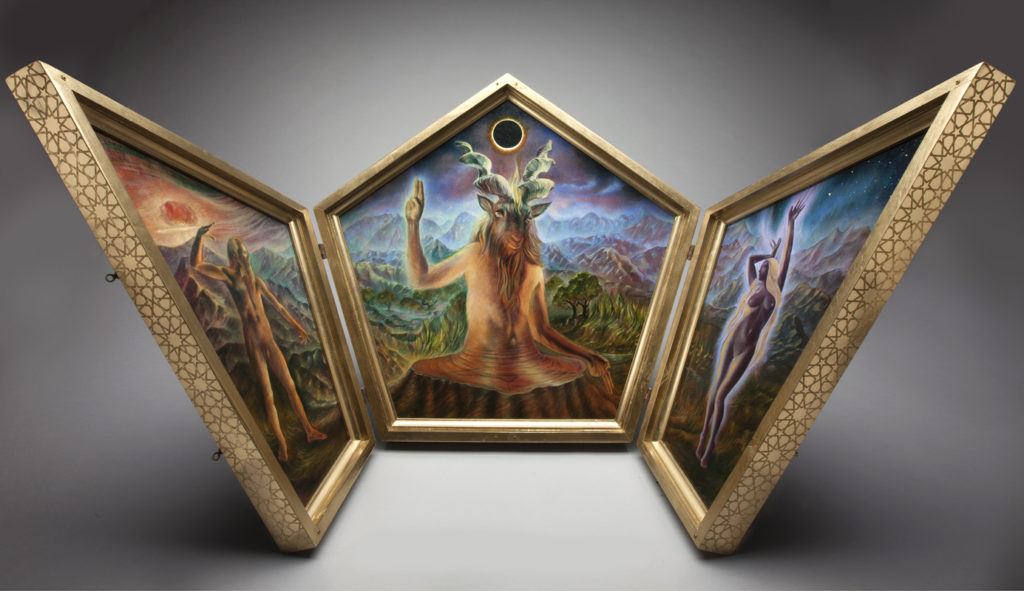
Oil & Tempera on Birch Panel
In collaboration with David Heskin
2015
ANIMA MUNDI
☉♈︎☾
⚭
This Netherlandish-inspired altar triptych, painted in egg tempera and oils on birch panel, was created for “The Garden of Fernal Delights”; an exhibition of international artists whose work was initially assembled in the book, “The Encyclopædia of Fernal Affairs”. The central mythic figure in this work is “Anima Mundi” (the world spirit). The horned god Pan, (aka Baphomet) is a deity known by many names, throughout many religions.


Excerpt from the Encyclopædia of Fernal Affairs:
“The Garden of Fernal Delights is a sublime and paradisiacal place where all the wonders of the natural world from the sexual to the surreal, the visionary to the instinctive, are celebrated as fundamental joys of being alive. The Garden is a multidimensional place where all is conscious and divinely intelligent from the animal to mineral to vegetable to the aetheric. This Garden of Delights knows no violence, no notion of original sin, no hierarchy, no fixed temporal system. Rather, it is a place of magic, of play and playfulness. It resides in the Garden of the heart and has no limit to its creativity.”
Excerpt from Peter J. Carroll, Liber Null:
“[The Anima Mundi] is the spirit of the life energy of our planet. All living beings have some extra quality in them which separates them from inorganic matter. The ancient shamans mainly sought to represent this force by the Horned God. In more modern times this force has reasserted itself in our awareness under the symbol of Baphomet.
“Baphomet is the psychic field generated by the totality of living beings on this planet. Since the Shamanic aeon, it has been variously represented as Pan, Pangenitor, Pamphage, All-Begettor, All-Destroyer, as Shiva-Kali — creative phallus and abominable mother and destroyer — as Abraxas — polymorphic god who is both good and evil — as the animal headed Devil of sex and death, as the evil Archon set over this world, as Ishtar or Astaroth — goddess of love and war — as the Anima Mundi or World soul, or simply as “Goddess.” Other representations include the Eagle, or Baron Samedi, or Thanateros, or Cernunnos — the horned god of the Celts. The appellation “Baphomet” is obscure, but probably arises from the Greek Baph-metis, union with wisdom.
“ Gods with Baphometic names and images reoccur throughout Gnostic teachings. No image can fully represent the totality of what this force is, but it conventionally shown as hermaphrodite god-goddess in the form of a horned human that includes various mammalian and reptilian characteristics. It should also resume protozoan, insectivorous, and floral symbolism for it is the animating spirit of everything from a bacterium to a tiger. If we succeed in creating machine consciousness, it will have to include mechanical elements as well. Between its horns a torch is usually positioned, for spirit is most easily visualized as light. The image should also include necrotic elements for it also encompasses death. Life and death are a single phenomenon through which the life force continually reincarnates. A denial of death is also a denial of life. The cellular mechanisms which allow life also make death inevitable, essential and desirable. All religions which deny death are basically anti-life. Have no fear – you have been, and will be millions of things; all you will suffer is amnesia. The sexual aspects of the god-goddess Baphomet are always emphasized, for sex creates life, and the sexuality is a measure of the life force or vitality, no matter how it is expressed.”
For us, this is a narrative of the Sacred Marriage: the union of polar opposites, an alchemical conjoining of opposing forces and the potential energy created by such a union. It is an alchemical depiction, rife with symbolism, meant to be understood metaphorically.
The Garden of Eden has been clear-cut. In the center stands the barren stump of the Tree of Life. The primordial archetypes of “Adam” and “Eve” invoke the egregore, conjuring the very life force of the Earth out of the tree, to re-grow it anew, while off in the distance wars rage on and Earth is ravaged by the actions of ignorance.
The Latin words SOLVE (separate) and COAGULA (join together), i.e., the power of “binding and loosing” are represented on the doors of the triptych (and reiterated in the opening and closing of the doors of the triptych).
Baphomet is usually portrayed with his two hands forming the sign of occultism, the one pointing up to the white moon of Chesed, while the other points down to the black moon of Geburah. This sign expresses the perfect harmony of mercy with justice. The theme of harmony and balance of polarities recapitulates in the depiction of the eclipse between the horns (wherein, the flame of intelligence is typically seen shining between the horns as the magic light of universal balance; the image of the soul elevated above matter).
Gevurah and Chesed are each one of the ten sephirot on the kabbalistic Tree of Life. Chesed is given the association of kindness, benevolence, mercy and love, while Gevurah is the essence of judgment, justice, limitation and restraint. Gevurah is associated in the soul with the power to restrain one’s innate urge to bestow goodness upon others, when the recipient of that good is judged to be unworthy and liable to misuse it.
Love and judgement, mercy and justice act together to create an inner balance in the soul’s approach to the outside world. While the right arm of Chesed operates to draw others near, the left arm of Gevurah reserves the option of repelling those deemed undeserving (even towards those to whom one’s initial relation is that of “the left arm repels,” one must subsequently apply the complementary principle of “the right arm draws near”). Ultimately, the might of justice becomes the power and forcefulness to implement one’s innate desire for kindness and mercy.